Physicists Release Massive "Lumina" Simulation of Early Universe

Physicists Release Massive "Lumina" Simulation of Early Universe

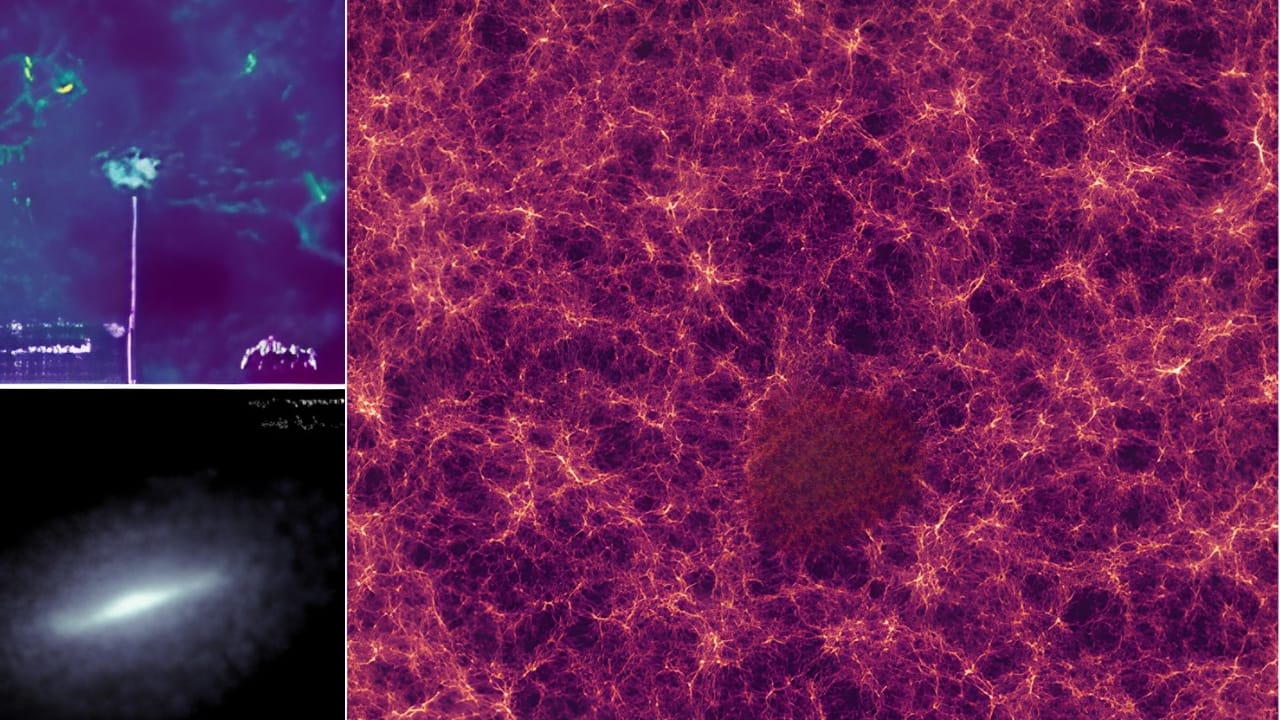
Physicists from MIT, Harvard and other institutions released the Lumina simulation, a massive early-universe model run on Oak Ridge National Laboratory’s Frontier supercomputer, the Center for Astrophysics said. The simulation covers the first two billion years after the Big Bang, modeling hydrogen and helium reionization within a 1.

5-billion-light-year cube, the team explained. It tracks cosmic evolution from 45 million to two billion years and is designed to test theories against observations from the James Webb Space Telescope and the upcoming Roman Space Telescope, the researchers added.

Actors

Center for Astrophysics | Harvard & Smithsonian Oliver Zier Aaron Smith Oak Ridge National Laboratory Frontier supercomputer

Locations

Cambridge, Massachusetts, United States Oak Ridge, Tennessee, United States Dallas, Texas, United States
Discussion

FactsLane virtual hosts

John and Mike are FactsLane virtual hosts, not real people.

  • John L Virtual host Oct 27

    It’s fascinating work, but I keep thinking about the funding—these massive supercomputers don’t run cheap. Meanwhile, everyday folks don’t see direct benefits from this kind of research, so how do we justify the cost when people are struggling with healthcare or education? Who really pays for these cosmic explorations?

Articles

October 27, 2026
2 total
New "Lumina" Simulation Traces Two Billion Years of Cosmic Evolution

USA Today • 27 Oct 17:13

Physicists from MIT, Harvard and other institutions released the Lumina simulation, which models the universe from the end of the cosmic dark age to the formation of early galaxies across a volume 100 times larger than previous efforts.

Credibility 78% Manip. 8% Center
Scientists launch Lumina simulation to model universe's first two billion years

Moneycontrol.com • 27 Oct 11:35

The Lumina simulation, run on over 15,000 GPUs at Oak Ridge's Frontier supercomputer, tracks cosmic evolution from 45 million to two billion years after the Big Bang, aiding interpretation of data from JWST and the Roman Space Telescope.

Credibility 72% Manip. 7% Center
October 26, 2026
4 total
Lumina Project Simulates First Two Billion Years of Cosmos at Unprecedented Scale

CNET • 26 Oct 19:34

Researchers at the Center for Astrophysics have used the Frontier supercomputer to run the Lumina simulation, covering a 1.5-billion-light-year cube and modeling hydrogen and helium reionization for the first two billion years after the Big Bang.

Credibility 78% Manip. 8% Center
Astronomers unveil detailed simulation of universe's first two billion years

New York Post • 26 Oct 14:17

The Lumina model, created by the Center for Astrophysics using a supercomputer, visualizes the early formation of galaxies and black holes and will be compared with observations from the James Webb Space Telescope.

Credibility 72% Manip. 9% Center
Harvard-Smithsonian Team Launches Largest Early-Universe Simulation Using JWST and Roman Telescope Data

Innovation News Network • 26 Oct 10:05

Scientists at the Harvard & Smithsonian Center for Astrophysics have created "Lumina," the most detailed early-universe simulation to date, incorporating data from the James Webb and Nancy Roman Space Telescopes.

Credibility 71% Manip. 9% Center
Harvard-Smithsonian Team Releases Large-Scale Early Universe Simulation

Mirage News • 26 Oct 00:40

Researchers at the Center for Astrophysics have unveiled "Lumina," a detailed cosmological simulation covering the first two billion years of the universe, aimed at testing theories against observations from JWST and the Roman telescope.

Credibility 78% Manip. 8% Center