Researchers Quantify Uncertainties in Upper Edge of Black Hole Mass Gap


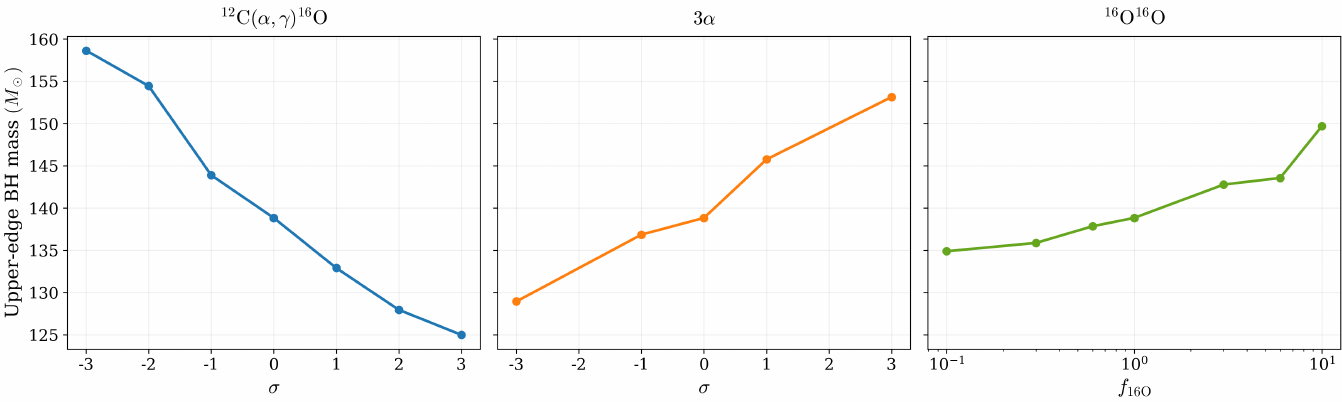
Researchers conducted a series of simulations to assess how variations in stellar-evolution inputs influence the upper boundary of the pair-instability supernova black-hole mass gap. The analysis showed that theoretical uncertainty is largely driven by nuclear reaction rates. The 12C(α,γ)16O reaction and the triple-α process were identified as the dominant contributors to this uncertainty.
The findings were reported by Sciencecast. The study highlights the need for more precise measurements of these nuclear rates to improve black-hole mass predictions.
Acteurs
researchers
Lieux
Aucun enregistrement